Game Guide › Start Here
🀄 Welcome to the table
PLAYCODE3 Mahjong is a four-seat tile game played on a painted 3D table. You draw one tile, you discard one tile, and you build a winning hand of . The computer can fill any empty seat, so a game is always possible, day or night.
This page is the long answer to everything. For the short answer, watch the video below. For a quick question mid-game, ask , the panda in the corner.
▶ Watch how to play, in 3½ minutes
The fastest start is the narrated video: 13 short chapters, from your first draw to your first Mahjong. You can pause and step back at any point.
Signing in, without a password
There are no passwords here, ever. Sign in with Gmail, Microsoft, Apple, or an emailed 6-digit code. One account keeps your coins, level, stats, friends, and private room on every device you play from.
Your name at the table
Your table name is whatever you type in the lobby, up to 20 characters. It is never copied from your Google or Apple account. You can change it any time: edit the field in the lobby and it saves by itself, everywhere, including what your friends see.
Your look
Three ways to pick a face for your seat:
- Upload a photo (or take one with your camera). It is cropped to a neat square for you.
- Choose a Character: a free gallery of hundreds of painted portraits. People with filters for gender, background, and age, plus animals: dogs, cats, rabbits, birds, and more.
- ✨ Generate a Character: describe anyone you can imagine, pick a style (Realism, Watercolor, Anime, or Pixar 3D), and the game paints 3 portraits for you to choose from. Every account gets 3 free portraits for life; more will be available later. You can download a portrait to your computer with the ⬇ button, so a favorite is never lost.
The narrator
A real voice calls the game: discards, claims, and a personal word when you win or lose. Pick from 7 narrators, each with a preview: Brian (the default), Anika, Freya, Ruthie Jo, Amelia, Lily, and Abigail. You can switch narrators mid-game from the sound panel, and there are separate volume sliders for the voice and the tile sounds.
📜 The tiles
The wall holds 136 tiles: four copies of every tile, and no jokers or flower tiles.
Three number suits, each running 1 to 9:


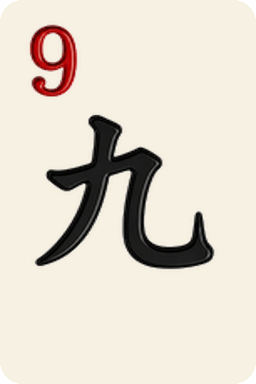

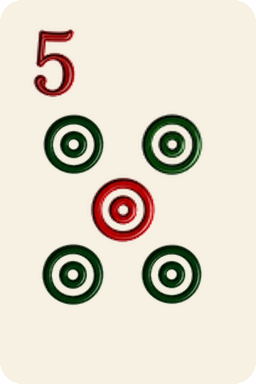
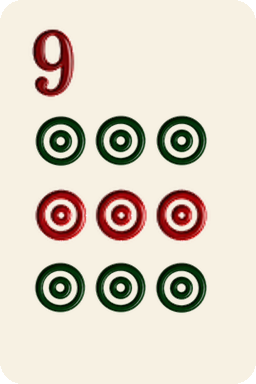
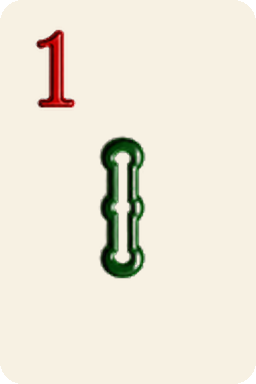
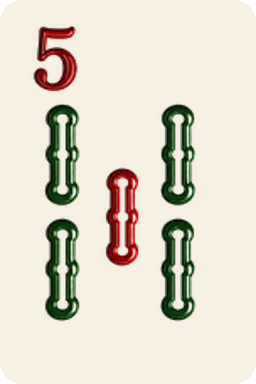
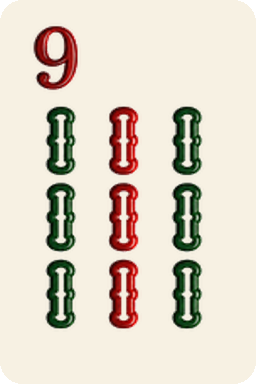
Characters, Circles, and Bamboo. Then the honor tiles: the four Winds, and this table's three special tiles.

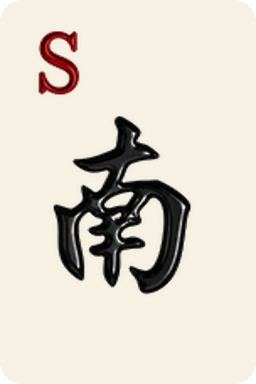

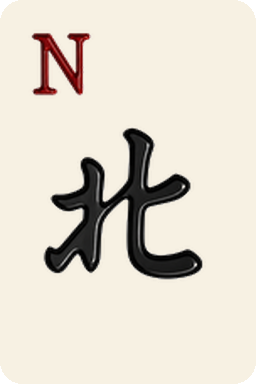



The green Dragon, the red Phoenix, and the white Mirror stand where classic sets put their three dragons. The Mirror's face is blank on purpose: it reflects.
The dice roll
Every game opens with a small ceremony: each player rolls two dice, in seat order. The highest total deals first and plays as East. A fresh roll starts every game, so the deal moves around the table the way luck decides.
A turn
Everyone is dealt 13 tiles. On your turn you draw one tile from the wall, then discard one, keeping 13 in hand. The dealer draws first. If the tile you draw completes your hand, press MAHJONG and the game is yours. Play moves clockwise until someone wins, or the wall runs out, which is a tie and .
The winning hand: 4 sets and a pair
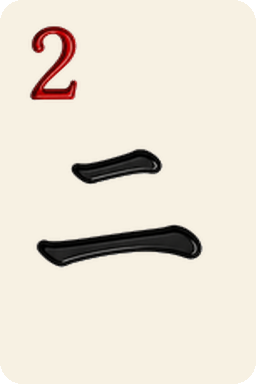
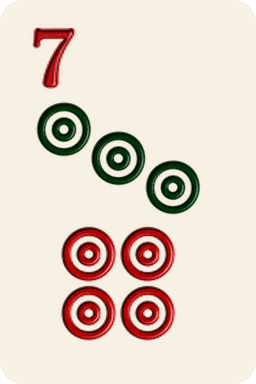
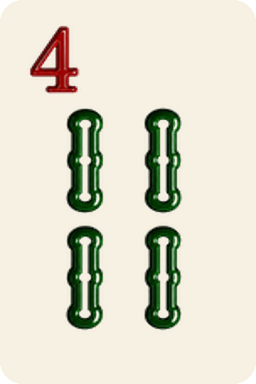
Fourteen tiles at the finish: four sets of three (a Kong counts as a set, with four) plus one pair. A set is a Pong (three identical), a Chow (three same-suit numbers in a row, like Bamboo 4-5-6), or a Kong (four identical). Here is one winning hand, taken apart:

 Chow
Chow
 Pong
Pong
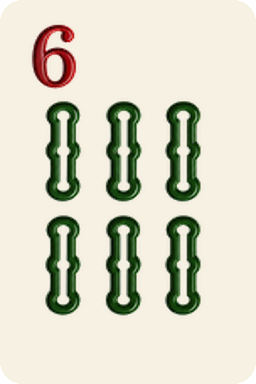 Chow
Pong
The Pair
Chow
Pong
The Pair
Claiming a discard: try it
When another player discards a tile you want, you can claim it. Say the player before you throws Bamboo 5. Tap a button below to see each claim built from that one tile:
← the discard- Chow: a run of three. You can only Chow from the player just before you, the one on your right. It is your turn next anyway; the run just starts it.
- Pong: three of a kind. You hold two, and you may claim the third from any player.
- Kong: four of a kind. Claim the fourth from any player, declare a concealed Kong on your own turn when you drew all four yourself, or add a fourth tile you draw to a Pong you already have exposed. Each way you draw a replacement tile (wall permitting), so a Kong never leaves you short.
- Mahjong: the winning claim. See .
A claimed set is placed face up, the tile leaves the discard pond, and you discard next. The table pauses briefly after every discard so claims can happen; a player weighing a real claim is never rushed off it.
Who gets the tile: this table's twist
Two players may want the same discard. The house priority is:
WIN beats CHOW beats PONG and KONG
Most mahjong tables let a Pong jump ahead of a Chow. Not here, and it is on purpose. The next player's turn is next; if they want the tile for a run, the run wins. A winning claim beats everything, always. When two players could win on the same tile, it goes to the seat whose turn comes soonest after the discarder.
The universal winning claim
If you are one tile from Mahjong and any player discards exactly that tile, you may take it and win on the spot, no matter where you sit. This applies only to the final winning tile. It stays winnable right up until the next player actually draws, so a sharp eye can still call Mahjong a beat after everyone else passed.
Kongs, in full
- A Kong is four identical tiles, melded face up (or concealed, from your own draws).
- Declaring one draws you a replacement tile from the wall. If the wall is already empty there is no tile to draw, so the hand ends there as a draw and nobody pays.
- A Kong is never needed to win. Four sets and a pair wins, with or without one. What a Kong does is money: it .
Coins and scoring
The score is coins. Everyone starts with 500 golden coins.
- Win a hand, and each of the three other players pays you 10 coins.
- Win while holding a Kong and that is a double win: 20 coins from each player. Two Kongs, 40 from each. Every Kong in the winning hand doubles it again.
- The Kong shield: a losing player holding their own Kong pays nothing that hand.
- The wall runs out with no winner: a tie, and nobody pays.
Coins carry across games in a room, and your balance follows your account between sessions. Coins are the bragging rights of the table; they are score, not money, and have no cash value.
Discard wisdom
Three habits that separate the table regulars from the tourists:
- Lone honor tiles go first. A single Wind, Dragon, Phoenix, or Mirror has only three matching tiles in the whole wall and can never join a run. If it has no partner by the early game, let it go.
- Never throw a suit tile before a lone honor. A lone Circles 8 still has live futures: 6-7-8, 7-8-9, or a pair. The lone honor has almost none.
- Never discard an honor you hold two or three of. That is a pair or a Pong in progress, and pairs win games.
Rulesets
🏮 PLAYCODE3 House Rules (what you just read) is the table today: fast, friendly, coin-scored, with the Chow-beats-Pong twist and the universal winning claim.
🇭🇰 Hong Kong rules · coming soon. The classic Cantonese game: the same draw-and-discard heart, but hands are scored in faan (points for hand patterns like an all-Pong hand or a one-suit hand), a minimum hand is required to win, and payouts scale with the rarity of what you built. When it arrives, you will pick the ruleset for a room the way you pick seats. Rules on this page will grow a full Hong Kong chapter then.
🎮 Solo and Online
Solo is you and three computer players, instantly, free. Your solo wins count. They move your just like online wins do.
Online is the real table: public games with anyone, or private rooms with your people. Every online win counts, whether the seats hold humans or AI, hints on or off.
Public tables and the Ready Check
Tap Quick Play, take an open seat, and you are in line to play. Anyone seated can fill an empty seat with an AI player. When four seats fill, the Ready Check begins: everyone gets 15 seconds to tap TAP TO PLAY. Miss it and the seat politely opens for the next player. Public tables are unlimited and free.
Private rooms, codes, and invites
A private room is your own table with a door. The host creates it (that is the ), and the room gets an 8-character room code. Share it two ways:
- Copy Code: friends type it into the JOIN box in the lobby.
- Copy Invite Link: one tap for them; the link lands with the code pre-filled and a JOIN button waiting.
Joining someone's room is always free. Only creating rooms is paid. The host fills empty seats with AI, invites friends, or opens seats to online players by name.
Leaving and rejoining
Life happens mid-hand. If you close the tab, lose signal, or hit LEAVE THE ROOM, your seat waits: an AI stands in, and rejoining with the same room code puts you right back in your chair, hand intact. On your return the AI steps aside like nothing happened.
The action bar
The gold buttons under your hand are the whole game: PASS, DRAW, DISCARD, PONG, CHOW, KONG, MAHJONG, plus two helpers. GROUP lets you space your hand into little piles while you plan. 🔍 TILES shows any tile's status: how many copies are visible on the table and how many are still out there. Neither helper ever costs you your turn.
Action Hint Button Glow
When a claim is open to you, the right button glows. Only the best available claim glows: Mahjong over Kong over Chow over Pong. Hosts can turn the glow on or off for the whole table in ; with it off, the table shows a small "Claim hints off" badge so everyone knows it is a fair fight. The buttons work exactly the same either way.
⚙️ Manage Room, for hosts
The host's control panel, reachable from the waiting room, the in-game menu, or the pause screen:
- Players: remove a player, even mid-game; an AI takes the seat instantly so the game never stops.
- Empty seats: add an AI, invite a friend, offer the seat to an online player by name, open it to anyone, or close it.
- Action Hint Button Glow: the table-wide hint switch.
- Tile Style: pick the artwork on every tile for the whole table: Classic, Golden Retriever, American Fast Food, Chinese Food, and six holiday sets (4th of July, Christmas, Easter, Lunar New Year, Thanksgiving and Valentine's Day). Change it before the deal or mid-game, the same way you change narrators.
⏸️ Pause, for hosts
The host can pause a live hand. Every clock freezes, the AI holds its tiles, and everyone sees the pause curtain until the host resumes. Doorbell, kettle, grandchild: the table waits.
The idle clock
Online, when it is your move and you walk away, the table protects the other three: after 110 seconds a warning counts down, and at 120 seconds the AI plays that one move for you. Three AI rescues in one game and the AI takes the seat for the rest of that game. Come back any time; acting returns control to you.
Seeing the table your way
- 3D table: every game is played on the same realistic 3D table, on a computer, an iPad, or a phone.
- Zoom: clicking the felt zooms in and out. Zoom Lock (the 🔐 switch at the top left, next to 💡 Hint) pins your zoom with a simple on/off switch, so a stray click can never shrink your tiles. On an iPad, pinch the table or tap the + and − buttons beside it.
Table chat
Online tables have a chat tab with emoji, GIF search, photo sharing, and private whispers to one player. Friends have their own tab; see . Chat is moderated, and you can block or report any player from their message or their seat.
👑 The $4.99 Host Pass
One payment, $4.99, yours for life. No monthly fee, no subscription, nothing recurring. It makes you a host: the person with their own room.
What hosting gets you
- 🏮 Your own private room with a code and invite link to share.
- 🛡️ Control of the door: choose who plays, add or remove players any time, open and close seats.
- 💬 Private chat at your table, and the power to reply in friend messages.
- 🎬 Game replays of every finished game in your rooms, with sharing. See .
- 🀄 The 9 painted are an optional add-on: $5.99 for all nine, or $8.78 for the pass and the designs together.
What stays free forever
- Solo play, unlimited.
- Public tables, unlimited.
- Joining any friend's private room by code or invite link.
- Reading messages from friends.
💰 Coins
Coins are the table score. You start with 500, winners collect 10 from each player (doubled per Kong), and your balance rides along on your account. The full arithmetic lives in . Reaching big balances earns , and each new level pays a bonus of 10 coins × your new level.
Levels: 30 named ranks
Your level is your career of wins while signed in. Every one counts: solo or online, private or public room, against people or the computer, hints on or off. Each level costs a little more than the last: 5 × your current level in wins. Level 1 to 2 is 5 wins; 2 to 3 is 10 more; 3 to 4 is 15 more, and so on.
| Lv | Rank | Wins | Lv | Rank | Wins |
|---|---|---|---|---|---|
| 1 | Fresh Tile | 0 | 16 | Table Captain | 600 |
| 2 | Table Learner | 5 | 17 | Tile Whisperer | 680 |
| 3 | Tile Strategist | 15 | 18 | Fortune Builder | 765 |
| 4 | Pong Caller | 30 | 19 | Jade Master | 855 |
| 5 | Chow Weaver | 50 | 20 | Wall Breaker | 950 |
| 6 | Kong Keeper | 75 | 21 | Round Ruler | 1,050 |
| 7 | Wall Reader | 105 | 22 | Phoenix Player | 1,155 |
| 8 | Discard Detective | 140 | 23 | Golden Kong | 1,265 |
| 9 | Meld Maker | 180 | 24 | Table Legend | 1,380 |
| 10 | Table Tactician | 225 | 25 | Tile Sage | 1,500 |
| 11 | Wind Rider | 275 | 26 | Dragon Heart | 1,625 |
| 12 | Dragon Tamer | 330 | 27 | Grand Strategist | 1,755 |
| 13 | Golden Hand | 390 | 28 | Jade Champion | 1,890 |
| 14 | Silent Tenpai | 455 | 29 | Mahjong Master | 2,030 |
| 15 | Coin Collector | 525 | 30 | Grandmaster of Tiles | 2,175 |


Every level has its own painted emblem, worn at your seat. Level 30 is the top named rank; past it, the number keeps climbing.
The leaderboard
Two boards, live: Today (most wins today, reset at midnight Eastern) and All-Time. Your own row glows and scrolls into view. Ties share the crown. The lobby also keeps your private list of Recent Games: your last 20, with results and coin swings.
🏅 Badges
23 painted badges, in four families. Earned is earned forever; there are no progress bars, only the moment the popup surprises you. Tap any badge in your profile to see its art up close and how it is earned.
- Gameplay feats: Self-Draw, Kong Winner, Concealed Kong, Double Kong Winner, Universal Claim (a Pong, a Chow, and a Kong in one game), Wall Survivor (win on the very last tile), and Moon from the Bottom of the Sea (win with 16 or fewer tiles left in the wall).
- Winning streaks (online games): 2, 3, 4, and 5 wins in a row.
- Coin milestones: 1,000 · 10,000 · 100,000 · 1,000,000 coins.
- Victory milestones: your 1st win, then 10, 25, 50, 100, 200, 500, 1,000.
 First Win
 Self-Draw
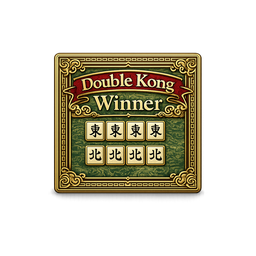 Double Kong
 5 in a Row
 Millionaire
 1,000 Wins
Victory Certificates
Win a hand and a red envelope opens in the ceremony. Out of it comes your Certificate of Victory: your name, your win number, your level and rank, the coins you won, how you won, the winning hand and the date, with a QR code that opens a public copy anyone can verify. Every confirmed win is certified automatically, whether or not you open the envelope. Print it, download it, share it, and find them all under Victory Certificates on your profile.
Golden Fortune Cookies
Lose a hand and a fortune cookie appears, with a deadpan word of comfort inside. But one game in every hundred hides a golden cookie: gold confetti, its own rare fortunes, and a permanent spot on your profile shelf. Nobody can buy one. You have to be there when it happens.
Recent games
Your last 20 games, kept in the lobby: won or lost, coins up or down, who you played, and when. A little diary of the table.
🎬 Game Replays
Every finished game in a private room records itself, automatically, for the room's host. Find yours at Profile → 🎬 My Replays, which lists every game from every room you have hosted.
How long games keep
Games keep for 90 days, newest 20 per room.
Star ⭐ a game and it is kept forever: up to 10 per room.
90 days is the shelf. The star is the freezer. The freezer holds ten.
Watching one back
The replay rebuilds the whole game move by move, every hand face up. Play, pause, step, scrub, or run it at up to 4× speed. Jump buttons take you straight to the big moments: every Pong, Chow, and Kong, 💔 The Fatal Discard (the second the winning tile hit the pond), and 🏆 The Win. The finish brings gold badges for rare hands, a Game In Numbers card, and a written story of how it all went down, including the lesson when somebody's wait was already dead.
Sharing a replay
🔗 Share Link copies a direct link to that one game. It opens for any player with a . Send your best game to the group chat and let them argue about the discard at move 41.
🤝 Making friends
Friends are made at the table, the old-fashioned way: at any online table, public or private, tap another player's name card and choose 🤝 Send Friend Request. When they accept, they join your Friends panel in the lobby, and their live status follows them: Online, In a Game, or Offline.
Who is up for a game
- "I am looking to play" puts a gold ring on your avatar so friends know you are game. It is on by default; switch it off any time.
- 👻 Appear offline lets you browse unseen. You still see your friends and still receive invites and notes.
Messages
Every friend is a conversation: private messages with read receipts, day separators, and unread counts. Reading is free for everyone. Replying takes the , the same one purchase that opens your own room. Messages are filtered to keep things friendly.
Getting a game together
- Invite to Room: an online friend gets your invite the moment your room opens.
- 🎮 Invite when their game ends: a friend mid-game gets your invite the moment they finish, and it waits up to about 30 minutes for them.
- 💌 A Let's-play note: an offline friend finds your gold note waiting the next time they sign in.
- 🔔 Tell me when they are online: a per-friend bell, for the friend you always want a game with.
🐼 Amanda Panda, your guide

The panda in the bottom-left corner of the game is Amanda. She knows every corner of this game: rules, coins, replays, the Host Pass, all of it, and she answers in your language. Type to her, or tap the microphone and just talk.
Her house rule: no tile hints, ever. She never sees your hand or the wall, and even if you show her a screenshot she will name the tiles and explain the rules, but she will never tell you what to play. The game stays yours to win.
What she can do
- Answer any question about rules, features, or money, in a couple of sentences.
- 📎 Look at a screenshot you attach, to understand what you are seeing.
- 🎤 Listen: tap the mic and speak your question; your words appear in the box.
- Point you to How to Play or to the bug report form when that is the real answer.
🐞 Reporting a bug or an idea
Found something broken, or thought of something better? The Report a Bug / Idea form lives in the ☰ menu, under Amanda's chat, and in the lobby. Describe what happened and attach up to 3 photos or short videos. It goes straight to the PLAYCODE3 team, and reports get read by people, not robots.
🎨 Tile sets and themes
Every table starts on the Classic set: ivory tiles, painted faces, the green Dragon, the red Phoenix, and the blank white Mirror. Nine more designs are live: three all-year sets and six holiday sets. The host of a private room picks one in Manage Room and everyone at the table sees it. All nine are one add-on to the : $5.99 for the lot, every future design included, or $8.78 for the pass and the designs together.
On the table now
 Golden Retrieveravailable now
 American Fast Foodavailable now
 Chinese Foodavailable now
 4th of Julyavailable now
 Christmasavailable now
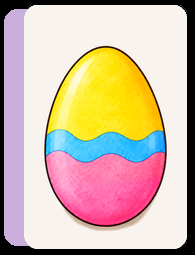 Easteravailable now
 Lunar New Yearavailable now
 Thanksgivingavailable now
 Halloweenavailable now
 Valentine's Dayavailable now
Same game, same rules, different joy: kibble for dots and four full-body retrievers for the winds in the dog set; donuts, nuggets, and a burger Dragon in the fast food set; dumplings and a teapot in the Chinese Food set; and for the holidays, everything from popsicles and rockets to gingerbread men, Easter eggs, red envelopes, acorns and hearts. Every numbered tile in every set carries the same big red index in the top-left corner, so a set never costs you reading speed.
Who can change them
Only the host of a private room can switch sets, in under Tile Style, before the deal or in the middle of a hand; it changes the tiles for everyone at that table. Public Quick Play and Solo stay Classic. A set never changes the rules and never touches the odds; they are wardrobe, not weaponry.
🏮 A short history of mahjong
Mahjong grew up in China in the middle of the 1800s, in the busy trading towns around the Yangtze delta near Ningbo and Shanghai. It descended from older Chinese card games whose suits of coins and strings of coins became the Circles and Bamboo on your tiles today. Merchants, boatmen, and families carried it upriver and down the coast, and within a couple of generations the clack of tiles was the sound of an evening in much of China.
Why is it called mahjong?
The name comes from máquè, "sparrow." Listen the next time a table shuffles: 136 tiles washing against each other sound exactly like a tree full of chattering sparrows. In much of China the game is still simply called the sparrow game, and one old story says the bird on the One of Bamboo flew in straight from the name.
Mahjong meets the world
In the 1920s the game crossed the ocean and became a full-blown craze in America: sets sold out, clubs formed, and newspapers printed rules columns. It found a lasting home in living rooms, especially among women who made the weekly game an institution of friendship that continues to this day. Different regions grew their own rules along the way: Hong Kong scoring, Japanese riichi, American charleston hands, and now, a certain .
Our table
PLAYCODE3 Mahjong plays the classic heart of the game, four sets and a pair, with a few house choices made for warmth and speed: the , the , coins instead of point tables, and three honors of our own: the green Dragon, the red Phoenix, and the white Mirror. Classic rulesets like are on the road map, so the traditionalists will have their day too.
❓ Questions, answered
Getting startedIs the game free?
Yes. Solo play, public online tables, and joining any friend's room are free, forever. The purchases are the , one time, for players who want their own private room, and an optional $5.99 pack of for that room.
What is my password?
There isn't one, on purpose. Sign in with Gmail, Microsoft, Apple, or a 6-digit code sent to your email. Nothing to remember, nothing to forget.
Can I change my name?
Any time. Edit the name field in the lobby and it saves itself, up to 20 characters. Friends see your current name automatically.
Can I play on my phone? My iPad? My computer?
Yes. Play on your phone, your iPad, or your computer, in the browser, with nothing to install. On a phone, turn it sideways at the game table. One sign-in carries your coins, level, and friends across your devices.
I have never played mahjong. Where do I start?
Watch the 3½ minute video, then play Solo with the on: the right button lights up whenever you can act. A few hands in, it clicks. Then read and go beat your family.
Do I need a Kong to win?
No. Four sets and a pair wins, with or without a Kong. A Kong is about coins: it doubles your win (20 from each player per Kong instead of 10) and shields you from paying when someone else wins. Think of it as insurance with a bonus.
Why did my Chow beat their Pong? That is not how my aunt plays.
House rule, on purpose: Win beats Chow beats Pong and Kong here, because the Chow claimer's turn was next anyway. Your aunt's table is welcome to argue; ours keeps the line moving. The classic priority returns with the , coming later.
Can East-South-West be a run?
No. Honor tiles (Winds, Dragon, Phoenix, Mirror) never form a Chow. They only work as a pair, a Pong, or a Kong.
My Mirror tile is blank. Is that a bug?
It is the design. The white Mirror reflects, so its face is empty on purpose. It is this table's third special tile, alongside the green Dragon and the red Phoenix.
What happens when the wall runs out?
A tie. Nobody pays, nobody collects, and the next game starts with a fresh dice roll. Sometimes the wall wins.
Who deals? Does the dealer get an extra tile?
Every game opens with a two-dice roll; the highest total deals and plays first as East. Everyone gets exactly 13 tiles, the dealer included; the dealer simply draws first.
Are coins worth real money? Is this gambling?
No and no. Coins are score: they cannot be bought, sold, or cashed out, ever. The game is entertainment for players 13 and up. The only real-money items are the one-time and the optional $5.99 pack of .
Is the AI cheating? It always seems lucky.
The AI sees only its own hand, the same as you. The wall is shuffled with cryptographic randomness, and the dice ceremony gives every seat an exactly equal chance to deal. Losing streaks feel personal; the mathematics is not.
Do wins against the AI count?
Yes: every win counts toward your level, badges, and the leaderboard, solo or online, whether the other seats held people or the computer.
What is your refund policy on the Host Pass?
The pass is a one-time $4.99 with no recurring anything, and it is yours for life. If something about your purchase went wrong, write to contact@playcode3.ai and a person will sort it out.
My friend sent me a room code. Do I have to pay?
No. Joining a room is always free. Sign in, type the code in the JOIN box (or just open their invite link), and take your seat. Only the person who creates rooms needs the pass.
My internet dropped mid-game. Did I lose everything?
No. An AI holds your seat and your hand, and when you come back (same room code, or the rejoin prompt in the lobby), you take over exactly where you left off.
The AI made a move for me. Why?
The idle clock. Online, if it is your move and nothing happens for 120 seconds, the AI plays that one move so three other people are not held hostage by a phone call. It warns you first, and three rescues in one game hands the seat to the AI for that game. Just act, any move, and it is yours again.
Someone unpleasant is at my table. What can I do?
In your own room, open and remove them; an AI takes the seat instantly. Anywhere, you can block a player's messages from the ⋯ on their message, or report them to the team. Chat is also filtered automatically.
Where are my replays?
Profile → 🎬 My Replays. Replays record automatically in private rooms you host. They keep 90 days (newest 20 a room); star ⭐ up to 10 a room to keep them forever. Full story in .
Can we take a break mid-game?
In a private room, yes: the host can . Every clock freezes and the game waits, tiles exactly where you left them, until the host resumes.
Can we turn the hint glow off for a serious game?
Yes. The host flips off for the whole table in Manage Room. Everyone sees a small "Claim hints off" badge, so nobody wonders.
What is a Victory Certificate?
Every hand you win while signed in is certified: your name, your win number, your level and rank, the coins you won, how you won, the winning hand and the date, with a QR code that opens a public copy anyone can verify. Print it, download it, share it, and find every one under Victory Certificates on your profile.
What is the golden fortune cookie everyone mentions?
A 1-in-100 event. Ordinary hands end with an ordinary cookie; one game in a hundred hides the golden one, with rare fortunes and a permanent place on your profile. See .
Can I change the narrator's voice?
Any time, even mid-game, from the sound panel: 7 voices with previews, plus separate volume sliders for voice and tile sounds, and mute.
Why won't Amanda tell me what to discard?
House rule, and she is firm about it: she guides the game, she never plays it for you. She cannot see hands or the wall at all, so the game stays fair. She will happily explain any rule that makes the choice yours. See .
The table keeps zooming when I click. Help?
That is felt-click zoom. Switch on 🔐 Zoom Lock (top left, next to 💡 Hint): your size stays put, remembered every visit.
Do my old games count toward new collections?
Collections count from the moment they exist. Golden cookies, for example, began counting in July 2026, and Victory Certificates in September 2026; wins before a collection existed are honored in your totals but not on the new shelf.
ℹ️ About the game
PLAYCODE3 Mahjong is made by PLAYCODE3 LLC, a family company. Our family designs the tables, tiles, and characters with AI art tools, most narrator voices are made with AI voice technology, and the bug reports really are read by the people who build the game.
Your privacy, in plain words
- Signing in stores your email, your chosen name and avatar, and your game record. That is it: no address, no phone number, no payment card on file, and nothing is ever sold.
- Your chosen name and avatar are visible to the people at your table, the way your face is visible at any table.
- You can change your name and avatar any time, and you can ask for your data to be deleted.
The full policy lives at Privacy Policy.
The house promises
- 13 and up. This is a table for teens and grown-ups.
- No gambling. Coins have no cash value and never will.
- No subscriptions. The one purchase is one-time.
- Fair shuffles. Cryptographic randomness, equal odds at every seat, and an AI that sees only its own hand.
Reaching us
The fastest road is the 🐞 form in the game. For anything else: contact@playcode3.ai.